
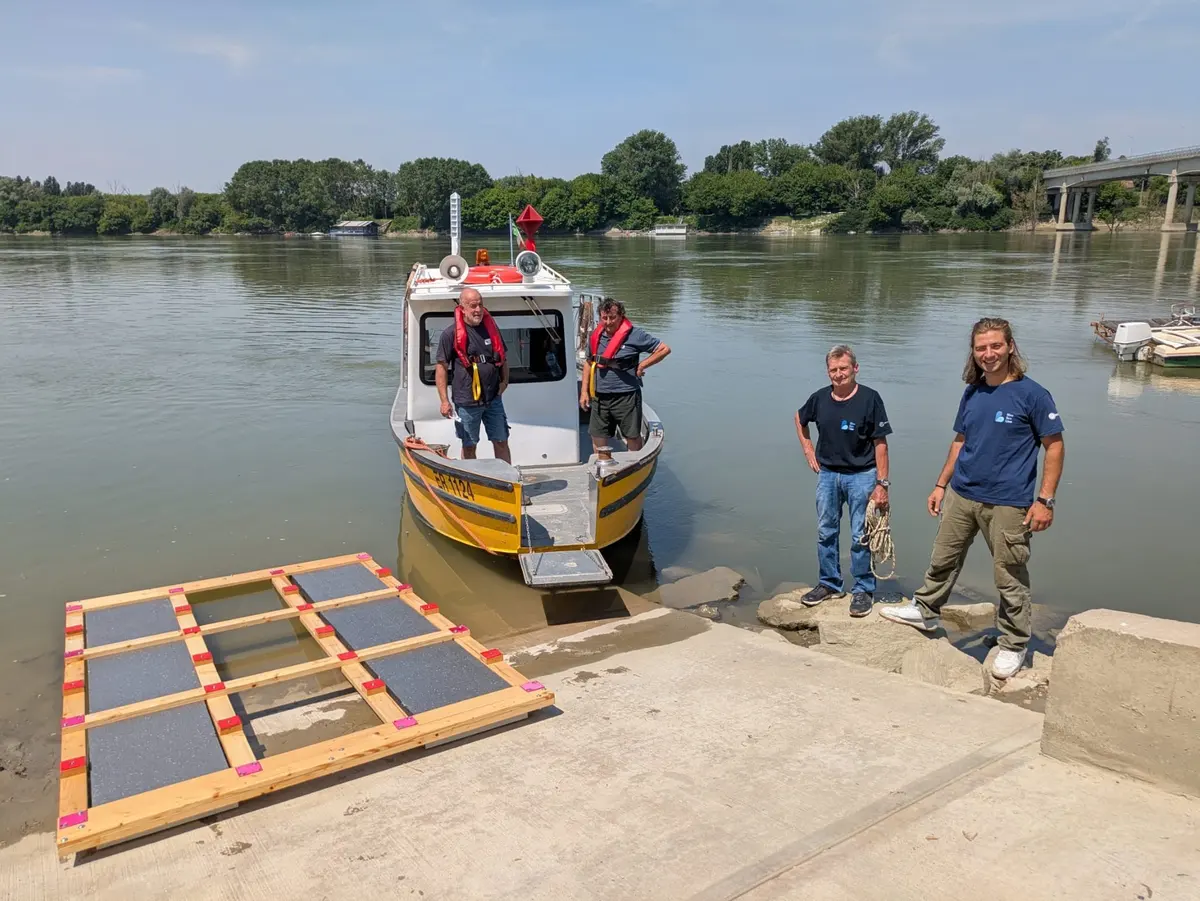
Ficarolo, 10 June 2026 – Blue Eco Line returned to the Po, in the Municipality of Ficarolo, for a calibration session of the River Eye cameras installed on the bridge between Ficarolo and Bondeno. The aim was to acquire the data needed to build the geometric transformation matrices that will allow the system to derive the real dimensions of objects from the images it captures.
Calibration is a technically necessary step to bring the monitoring to a higher level of detail. Without it, River Eye identifies and classifies waste in transit but has no information on its actual size. With the transformation matrices in place, the system will be able to estimate the volume and surface area of each floating object, both plastic and wood. This is relevant information for anyone planning interventions on the river: knowing how much material is moving, not just what type, significantly improves the quality of decision support.
For the calibration, a target of approximately 3 by 2 metres was built, incorporating references of known dimensions selected to be easily recognisable by the AI systems and useful for triangulating position and calibrating each individual camera. The structure had to be brought under the cameras' field of view and held in position while the team captured the images. To do this, Blue Eco Line worked alongside AIPO — Agenzia Interregionale per il fiume Po (Interregional Agency for the River Po), which provided a vessel and field operators. The collaboration took place within the Salvamare project, in which AIPO is an active participant: the operators on the ground demonstrated both expertise and full availability, making a logistically demanding operation possible.
The Salvamare project has been running since 2024 in collaboration with the River Lab of the Department of Geosciences at the University of Padua, which requested the installation of the cameras from Blue Eco Line, and with the Autorità di Bacino Distrettuale del Fiume Po (Po River Basin District Authority). The data collected on 10 June will feed into the development of the transformation matrices, moving the monitoring on this stretch of the Po toward a new operational phase in which measurements will gain a more precise quantitative dimension.